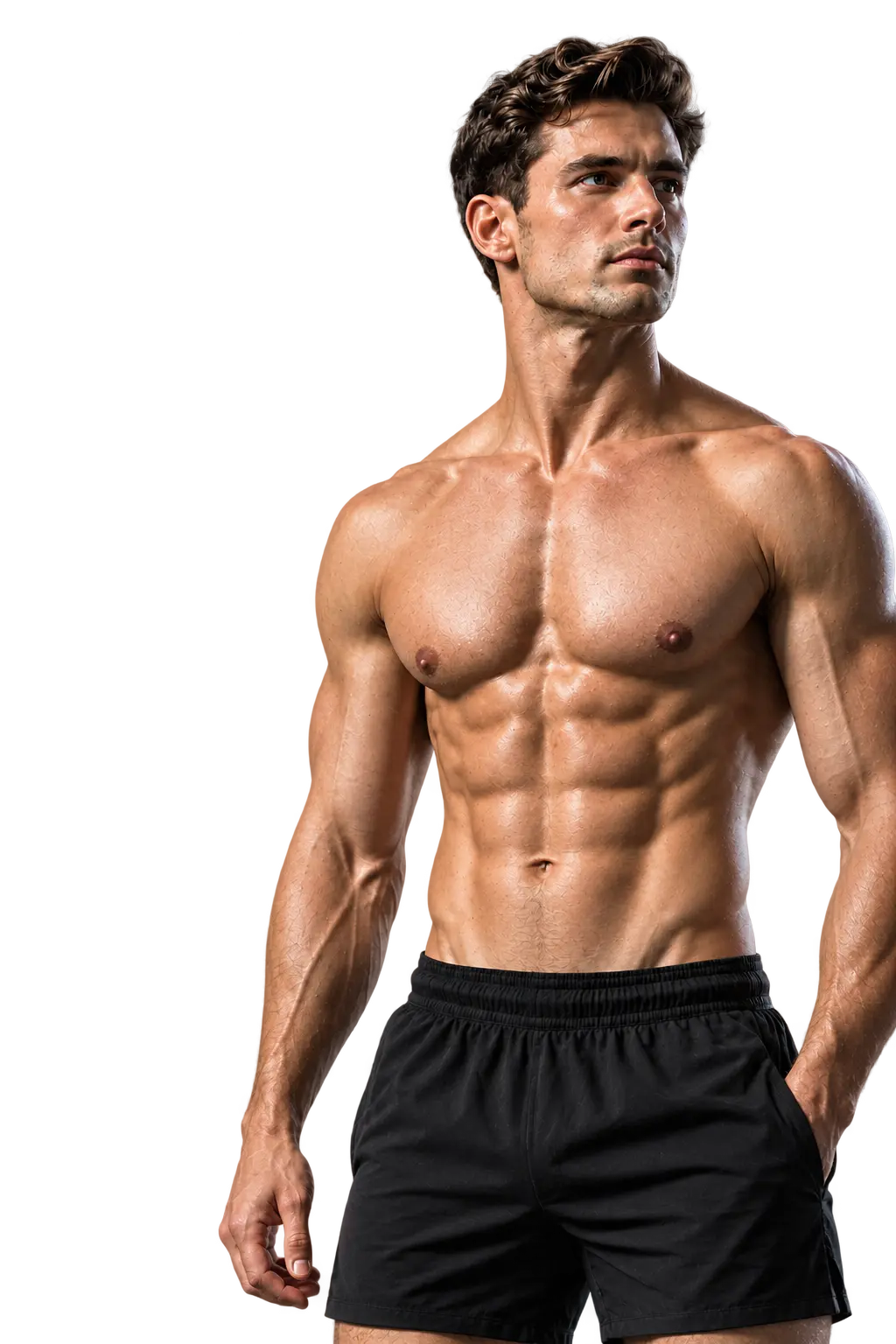
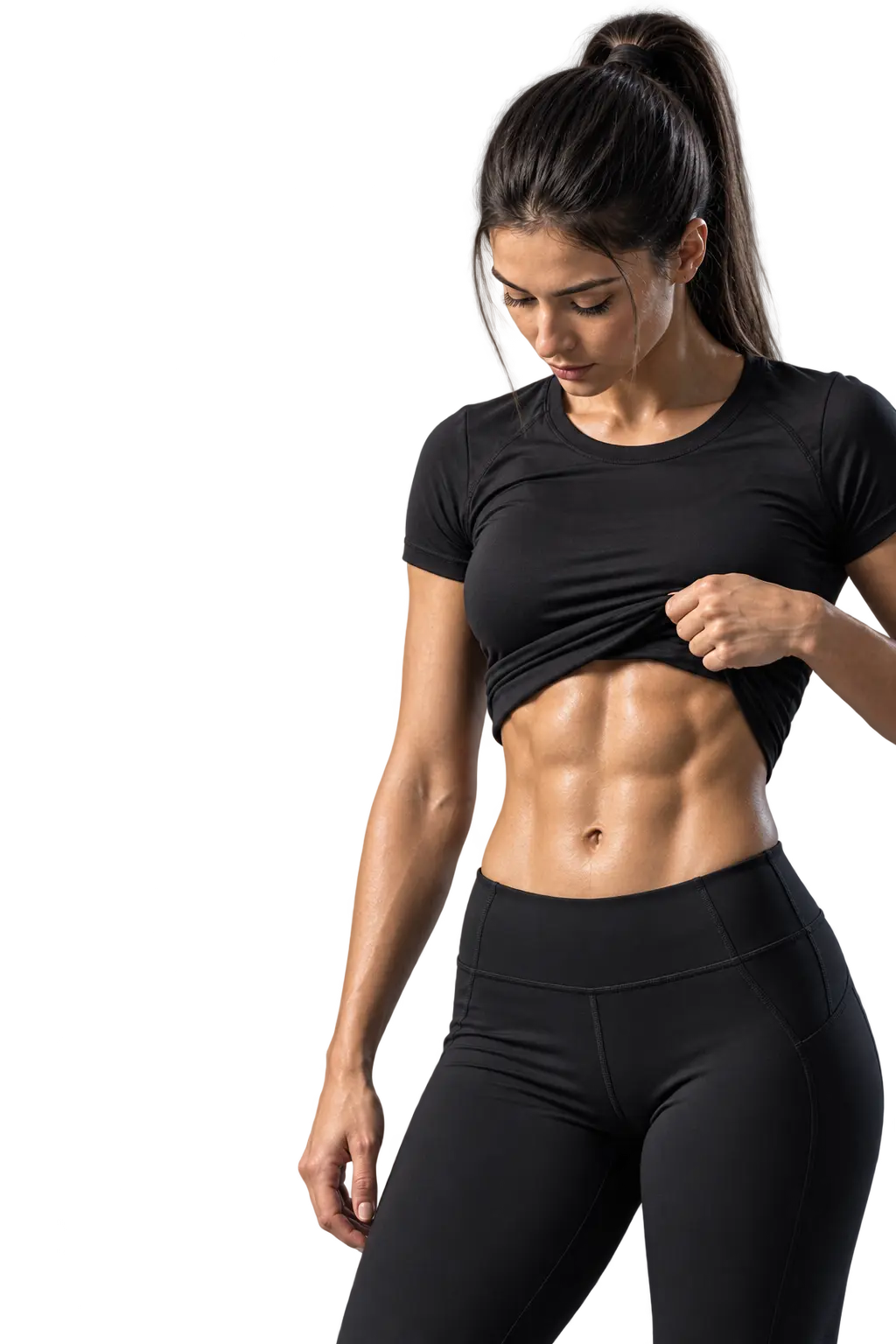
What is FFMI (Fat-Free Mass Index)?
FFMI, or fat-free mass index, measures how much lean mass you carry for your height. It takes your fat-free mass (everything in your body that isn’t fat) and divides it by your height squared, the same way BMI divides total weight by height squared. The index was introduced by VanItallie and colleagues in 1990 as a height-normalized index of fat-free mass for judging nutritional status. Because fat is removed from the equation, FFMI tells a muscular lifter apart from someone carrying extra fat, which BMI can’t do.
Fat-free mass includes muscle, bone, organs and water, so FFMI is an estimate of muscularity, not a direct measurement of muscle. Your result is only as accurate as your body fat number. Used consistently, though, it is one of the simplest ways to see how much muscle you’ve built and how close you are to your potential.
How To Use This FFMI Calculator
- Choose your sex. Male and female FFMI ranges and natural limits differ, so this sets the right comparison.
- Pick your units. Use ft · lb or cm · kg. Switching never changes your result.
- Enter your height and weight. Weigh yourself in the morning, before eating, for the most consistent number.
- Enter your body fat percentage. If you don’t know it, open “Don’t know your body fat?” and estimate it with a tape measure.
- Read your result. You’ll see your FFMI, normalized FFMI, range, percentile and how close you are to the natural limit.
- Plan and track. Set a target in the goal planner, then save each result to your log to see your progress over time.
FFMI Formula: Standard and Normalized
The FFMI calculator above uses two formulas. Standard FFMI is your fat-free mass in kilograms divided by your height in metres squared. The second adds a height adjustment so that taller and shorter people can be compared on the same scale.
The 6.1 constant comes from Kouri et al.’s 1995 study of fat-free mass index in steroid users and non-users. Some calculators use 6.3, which doesn’t match the paper. Pounds convert at 2.20462 per kilogram and inches at 2.54 cm.
Worked example in lbs (updates with your numbers)
Worked example in kg and cm
FFMI Chart: What is a Good FFMI for Men and Women?
This FFMI chart shows height-adjusted ranges by sex. The ranges describe training status, not health, and they overlap with nothing: each FFMI value falls in exactly one range.
| Range | Male | Female |
|---|---|---|
| Building a base | under 18 | under 14 |
| Average | 18–20 | 14–16 |
| Trained | 20–22 | 16–17.5 |
| Advanced | 22–23.5 | 17.5–19 |
| Highly advanced | 23.5–25 | 19–21 |
| Exceptional | 25+ | 21+ |
For most men who train, a good FFMI is 20 to 22, and 22 to 23.5 reflects years of serious lifting. Female lifters who train typically land at 16 to 17.5, and 17.5 to 19 is advanced. The average untrained adult sits around 19 for men and 15 for women (FFMI percentiles for adults aged 18 to 98, Schutz et al., 2002).
What is the Natural FFMI Limit?
The natural FFMI limit most people quote is about 25. It comes from Kouri et al. (1995), who measured 157 male athletes. The drug-free lifters in the study topped out near 25, while many of the steroid users were well above it. Kouri also looked at Mr. America winners from 1939 to 1959, before anabolic steroids were available, and their FFMIs clustered close to the same ceiling.
Treat 25 as a reference point, not a steroid test. Genetics vary, and a small number of drug-free lifters do exceed it. An underestimated body fat reading is the most common reason for a surprisingly high result: guessing 10% body fat when you are really 15% can add more than a full point to your FFMI. The natural limit line in the calculator shows how far you are toward 25, so you can see how much progress may be left.
Natural FFMI Limit By Height
The table below translates that limit into pounds and kilograms for each height. It shows the lean mass needed for an FFMI of 22 (advanced) and 25 (the limit), and what you would weigh at the limit at 10% and 15% body fat. Values use the normalized 6.1 formula.
| Height | Lean mass at FFMI 22 | Lean mass at FFMI 25 | Weight at 25, 10% body fat | Weight at 25, 15% body fat |
|---|---|---|---|---|
| 5’2″ (157 cm) | 113 lb (51 kg) | 129 lb (59 kg) | 144 lb (65 kg) | 152 lb (69 kg) |
| 5’3″ (160 cm) | 117 lb (53 kg) | 134 lb (61 kg) | 149 lb (68 kg) | 158 lb (72 kg) |
| 5’4″ (163 cm) | 122 lb (55 kg) | 139 lb (63 kg) | 155 lb (70 kg) | 164 lb (74 kg) |
| 5’5″ (165 cm) | 127 lb (57 kg) | 145 lb (66 kg) | 161 lb (73 kg) | 170 lb (77 kg) |
| 5’6″ (168 cm) | 132 lb (60 kg) | 150 lb (68 kg) | 167 lb (76 kg) | 177 lb (80 kg) |
| 5’7″ (170 cm) | 137 lb (62 kg) | 156 lb (71 kg) | 173 lb (79 kg) | 183 lb (83 kg) |
| 5’8″ (173 cm) | 142 lb (64 kg) | 162 lb (73 kg) | 179 lb (81 kg) | 190 lb (86 kg) |
| 5’9″ (175 cm) | 147 lb (67 kg) | 167 lb (76 kg) | 186 lb (84 kg) | 197 lb (89 kg) |
| 5’10” (178 cm) | 152 lb (69 kg) | 173 lb (79 kg) | 193 lb (87 kg) | 204 lb (92 kg) |
| 5’11” (180 cm) | 158 lb (72 kg) | 179 lb (81 kg) | 199 lb (90 kg) | 211 lb (96 kg) |
| 6’0″ (183 cm) | 164 lb (74 kg) | 186 lb (84 kg) | 206 lb (94 kg) | 218 lb (99 kg) |
| 6’1″ (185 cm) | 169 lb (77 kg) | 192 lb (87 kg) | 213 lb (97 kg) | 226 lb (102 kg) |
| 6’2″ (188 cm) | 175 lb (79 kg) | 198 lb (90 kg) | 221 lb (100 kg) | 234 lb (106 kg) |
| 6’3″ (190 cm) | 181 lb (82 kg) | 205 lb (93 kg) | 228 lb (103 kg) | 241 lb (109 kg) |
| 6’4″ (193 cm) | 187 lb (85 kg) | 212 lb (96 kg) | 235 lb (107 kg) | 249 lb (113 kg) |
| 6’5″ (196 cm) | 194 lb (88 kg) | 219 lb (99 kg) | 243 lb (110 kg) | 257 lb (117 kg) |
| 6’6″ (198 cm) | 200 lb (91 kg) | 226 lb (102 kg) | 251 lb (114 kg) | 266 lb (121 kg) |
For example, the natural FFMI limit for 5’10” (178 cm) works out to about 173 lb (79 kg) of lean mass, or roughly 193 lb at 10% body fat.
FFMI for Women
Women carry less fat-free mass than men at the same height, so female FFMI ranges sit about 4 points lower. An untrained woman typically has an FFMI near 15, a trained woman 16 to 17.5, and a highly advanced female lifter 19 to 21. Use the female setting in the calculator so your result is compared with the right ranges.
Kouri studied men only, and there is no equivalent study that sets an FFMI ceiling for them. The female ranges here are guidelines drawn from population data and coaching practice, and the calculator uses 21 as a rough reference.
For women over 50, lean mass tends to decline with age, and lean mass starts to fall during the menopause transition. Strength training slows it considerably. An older woman with an FFMI in the trained range is well ahead of most of her peers, so compare your result with your own past numbers as much as with the chart.
FFMI vs BMI
BMI divides total weight by height squared, so it can’t tell muscle from fat. The CDC’s guide to adult BMI lists this as one of its main limitations. A 5 ft 10 in lifter at 185 lb and 12% body fat has a BMI of 26.5, which BMI labels overweight. Their FFMI of 23.4 shows the weight is mostly lean mass.
How To Measure Body Fat for An Accurate FFMI
- DEXA scan: the most consistent option for tracking, though still an estimate.
- Tape measure (US Navy method): free and repeatable, based on the US Navy body fat equations for men and for women, and built into this calculator. Typically within a few percentage points.
- Skinfold calipers: good in trained hands, inconsistent when self-measured.
- Smart scales (bioimpedance): convenient, but readings shift with hydration.
Every 3 percentage points of body fat error moves FFMI by roughly 0.7 for a typical male. For tracking, use the same method under the same conditions each time.
Other Ways To Estimate Muscular Potential
FFMI isn’t the only way to estimate muscular potential. Casey Butt’s maximum muscular bodyweight model predicts maximum lean body mass from height plus wrist and ankle circumference, on the idea that bone structure limits how much muscle a frame can carry. It gives a more individual estimate, but it was built from data on elite bodybuilders and depends on careful measurement.
FFMI Calculator FAQ
What is a good FFMI for men?
A normalized score of 20 to 22 is good and typical after a few years of training. 22 to 23.5 is advanced, and 23.5 to 25 is close to the ceiling.
What is a good FFMI for women?
For a female lifter, 16 to 17.5 is good, 17.5 to 19 is advanced, and 19 to 21 is highly advanced.
What’s the difference between FFMI and normalized FFMI?
Standard FFMI is fat-free mass divided by height squared. The normalized version adds 6.1 × (1.8 − your height in metres) so that people of different heights can be compared fairly. The limit of 25 refers to the normalized number.
What’s the natural FFMI limit for 5’10” (178 cm)?
At 5’10”, an FFMI of 25 means about 173 lb (79 kg) of fat-free mass. That is roughly 193 lb at 10% body fat or 204 lb at 15%.
Is an FFMI over 25 natural?
It can be, but it’s rare. It is above what Kouri observed in drug-free athletes, but genetics vary and an underestimated body fat reading is common. No FFMI value proves steroid use on its own.
How accurate is my FFMI estimate?
The math is exact; the uncertainty comes from your body fat number. With a DEXA reading, expect your FFMI to be within about half a point. With a visual guess, it can be off by a point or more.
Can I calculate FFMI in kg and cm?
Yes. Switch the calculator to cm · kg. It converts everything to metric internally using exact factors, so switching between lbs and kg never changes your result.
How often should I track my FFMI?
Every 4 to 8 weeks is enough. Lean mass changes slowly, and day-to-day swings in water weight and body fat readings can hide real progress.
Is FFMI the same as lean body mass?
No. Lean body mass, or fat-free mass, is a weight in pounds or kilograms. FFMI divides that weight by your height squared, so people of different heights can be compared. Two lifters with the same lean mass can have very different FFMIs if one is much taller.
Does FFMI work for teenagers or older adults?
The ranges come from adults. Teens are still growing and lean mass declines with age, so read the estimate with that in mind.
Sources
- Kouri EM, Pope HG, Katz DL, Oliva P. Fat-free mass index in users and nonusers of anabolic-androgenic steroids. Clin J Sport Med. 1995;5(4):223–228.
- Schutz Y, Kyle UUG, Pichard C. Fat-free mass index and fat mass index percentiles in Caucasians aged 18–98 y. Int J Obes. 2002;26(7):953–960.
- VanItallie TB, Yang MU, Heymsfield SB, Funk RC, Boileau RA. Height-normalized indices of the body’s fat-free mass and fat mass: potentially useful indicators of nutritional status. Am J Clin Nutr. 1990;52(6):953–959.
- Hodgdon JA, Beckett MB. Prediction of percent body fat for U.S. Navy men from body circumferences and height. Naval Health Research Center, Report 84-11, 1984.
- Hodgdon JA, Beckett MB. Prediction of percent body fat for U.S. Navy women from body circumferences and height. Naval Health Research Center, Report 84-29, 1984.
- Greendale GA, Sternfeld B, Huang M, et al. Changes in body composition and weight during the menopause transition. JCI Insight. 2019;4(5):e124865.
- Centers for Disease Control and Prevention. About adult BMI.
- Butt C. Your maximum muscular bodyweight and measurements. The WeighTrainer.
This calculator provides estimates for educational purposes. It is not medical advice. Read the full disclaimer.
FFMI Calculator Pro

FFMI Calculator Pro for lifters, bodybuilders and fitness enthusiasts. Pick male or female, see your natural limit in lbs or kg, set a goal and track your progress.
Price Currency: USD
Operating System: Any
Application Category: HealthApplication